


 Cart
Cart
 sales@molnova.com


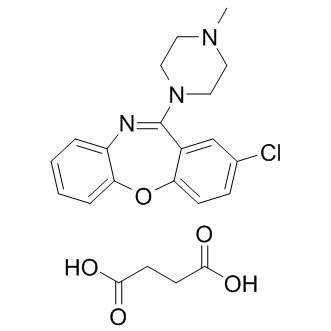
Loxapine succinate
CAS No. 27833-64-3
Loxapine succinate( CL 71,563 )
Catalog No. M13849 CAS No. 27833-64-3
A typical antipsychotic agent that displays an extremely strong binding affinity for dopamine D4 and serotonin 5-HT2 receptors.
Purity : >98% (HPLC)
 COA
Datasheet
HNMR
HPLC
MSDS
Handing Instructions
COA
Datasheet
HNMR
HPLC
MSDS
Handing Instructions
| Size | Price / USD | Stock | Quantity |
| 50MG | 30 | In Stock |


|
| 100MG | 42 | In Stock |
|
| 200MG | 68 | In Stock |
|
| 500MG | 150 | In Stock |
|
| 1G | Get Quote | In Stock |
|
Biological Information
-
Product NameLoxapine succinate
-
NoteResearch use only, not for human use.
-
Brief DescriptionA typical antipsychotic agent that displays an extremely strong binding affinity for dopamine D4 and serotonin 5-HT2 receptors.
-
DescriptionA typical antipsychotic agent that displays an extremely strong binding affinity for dopamine D4 and serotonin 5-HT2 receptors.Schizophrenia Approved(In Vitro):In the presence of Loxapine, [3H]ketanserin binds to 5-HT2 receptor in Frontal cortex of brain in human and bovine with Ki value of 6.2 nM and 6.6 nM, respectively. Loxapine has the rank order of potency for the various receptors appears to be as follows: 5-HT2≥D4>>>D1>D2 in comparing competition experiments involving the human membranes.Loxapine (0-20 μM, 24 h or 72 h) reduces IL-1β secretion by LPS-activated mixed glia cultures, reduces IL-2 secretion in mixed glia cultures, and decreases IL-1β and IL-2 secretion in LPS-induced microglia cultures.Loxapine (4 μM, 24 h) is active against multiple-antibiotic-resistant or Fluoroquinolone-resistant S. Typhimurium.Loxapine (1, 2, 4 and 8 μM) suppresses intracellular Methicillin-resistant S. aureus (MRSA), Y. enterocolitica and S. flexneri in RAW264.7.(In Vivo):Loxapine (5 mg/kg; i.p.; daily for 4 or 10 weeks) decreases serotonin (S2) but does not elevate dopamine (D2) receptor numbers in the rat brain.
-
In VitroIn the presence of Loxapine, [3H]ketanserin binds to 5-HT2 receptor in Frontal cortex of brain in human and bovine with Ki value of 6.2 nM and 6.6 nM, respectively. Loxapine has the rank order of potency for the various receptors appears to be as follows: 5-HT2≥D4>>>D1>D2 in comparing competition experiments involving the human membranes.Loxapine (0-20 μM, 24 h or 72 h) reduces IL-1β secretion by LPS-activated mixed glia cultures, reduces IL-2 secretion in mixed glia cultures, and decreases IL-1β and IL-2 secretion in LPS-induced microglia cultures.Loxapine (4 μM, 24 h)is active against multiple-antibiotic-resistant or Fluoroquinolone-resistant S. Typhimurium.Loxapine (1, 2, 4 and 8 μM) suppresses intracellular Methicillin-resistant S. aureus (MRSA), Y. enterocolitica and S. flexneri in RAW264.7.
-
In VivoLoxapine (5 mg/kg; i.p.; daily for 4 or 10 weeks) decreases serotonin (S2) but does not elevate dopamine (D2) receptor numbers in the rat brain. Animal Model:Adult male Wistar rats (150-175 g) Dosage:5 mg/kg Administration:Intraperitoneal injection, daily for 4 or 10 weeks Result:Induced a very significant reduction (more than 50%) of serotonin (S2) receptor density after 4 weeks or 10 weeks of daily injection, but did not produce any significant increase in dopamine receptor density.
-
SynonymsCL 71,563
-
PathwayGPCR/G Protein
-
Target5-HT Receptor
-
Recptor5-HT2(bovine)|5-HT2(human)|D2|D4
-
Research AreaNeurological Disease
-
IndicationSchizophrenia
Chemical Information
-
CAS Number27833-64-3
-
Formula Weight445.8961
-
Molecular FormulaC22H24ClN3O5
-
Purity>98% (HPLC)
-
Solubility10 mM in DMSO
-
SMILESCN1CCN(CC1)C2=NC3=CC=CC=C3OC4=C2C=C(C=C4)Cl.C(CC(=O)O)C(=O)O
-
Chemical NameButanedioic acid, compd. with 2-chloro-11-(4-methyl-1-piperazinyl)dibenz[b,f][1,4]oxazepine (1:1)
Shipping & Storage Information
-
Storage(-20℃)
-
ShippingWith Ice Pack
-
Stability≥ 2 years
Reference
1. Singh AN, et al. J Psychiatry Neurosci. 1996 Jan;21(1):29-35.
2. Labuzek K, et al. Eur Neuropsychopharmacol. 2005 Jan;15(1):23-30.
3. Lee T, et al. Psychiatry Res. 1984 Aug;12(4):277-85.
molnova catalog



related products
-
LY 272015 hydrochlor...
LY 272015 hydrochloride is an orally active and selective 5-HT2B receptor antagonist that displays antihypertensive effects in DOCA-salt hypertensive rats.
-
Befiradol
Befiradol (F13640, NLX 112) is a highly potent, selective 5-HT1A receptor agonist with Ki of 2.7 nM.
-
WAY-100635 maleate (...
WAY-100635 is a potent and selective 5-HT1A receptor antagonist; also acts as potent full agonist at the D4 receptor.
